 Mavera Docs
Talking to your audience
Chat, focus groups, interviews, and debates — when and how.
Run an audience conversation
Choose the format, audience, topic, and read dynamics honestly.
Choose Talk from the sidebar.
Good afternoon
Choose a surface from the sidebar to begin.
- 1Open TalkChoose Talk from the sidebar.
- 2Choose a formatSelect chat, focus group, deep interview, or debate.
- 3Choose the roomPick a named audience for the conversation.
- 4Give the room tensionWrite a focused, arguable topic rather than a vague prompt.
- 5Run the conversationStart the local simulation.
- 6Read the roomOpen the transcript, themes, and disagreement panel.
Plain chat (the simplest thing that works)
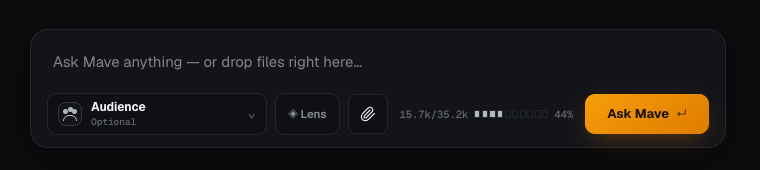
From Talk, hit the Chat card — or in any Mave conversation, open the 👥 Audience picker and select who you're talking to. Then just type.
Good chat questions:
- "What would make you switch from your current provider?"
- "React to this tagline: Know where the good boy is."
- "Walk me through the last time you bought this category."
The audience answers in first person, grounded in its profile. Ask for a show of hands, ask them to argue, ask the skeptics separately — it's a conversation.
Focus groups
Pick Focus Group, choose an audience from the dropdown, give it a topic. 4–8 personas discuss it and react to each other. You get:
- The full transcript, speaker by speaker
- Where the group converged (agreement themes)
- What split them (polarizing points)
- Who changed their mind (shifts during discussion)
All computed from the transcript in code — not summarized by vibes.
Deep interviews
One persona, laddered: every answer gets a "why" until you hit root motivation. Use when a segment's reasoning matters more than its distribution.
Debates
Two opposing personas argue a motion ("This product is worth a $15/mo subscription"). The most efficient way to hear the strongest version of both sides.
Reading the dynamics honestly
Every conversation output carries a grounding badge. category-modeled means the personas are built from category knowledge. Treat themes and language as modeled hypotheses worth testing, not observed market behavior.